Fiber
Fiber Connect
 Omnipub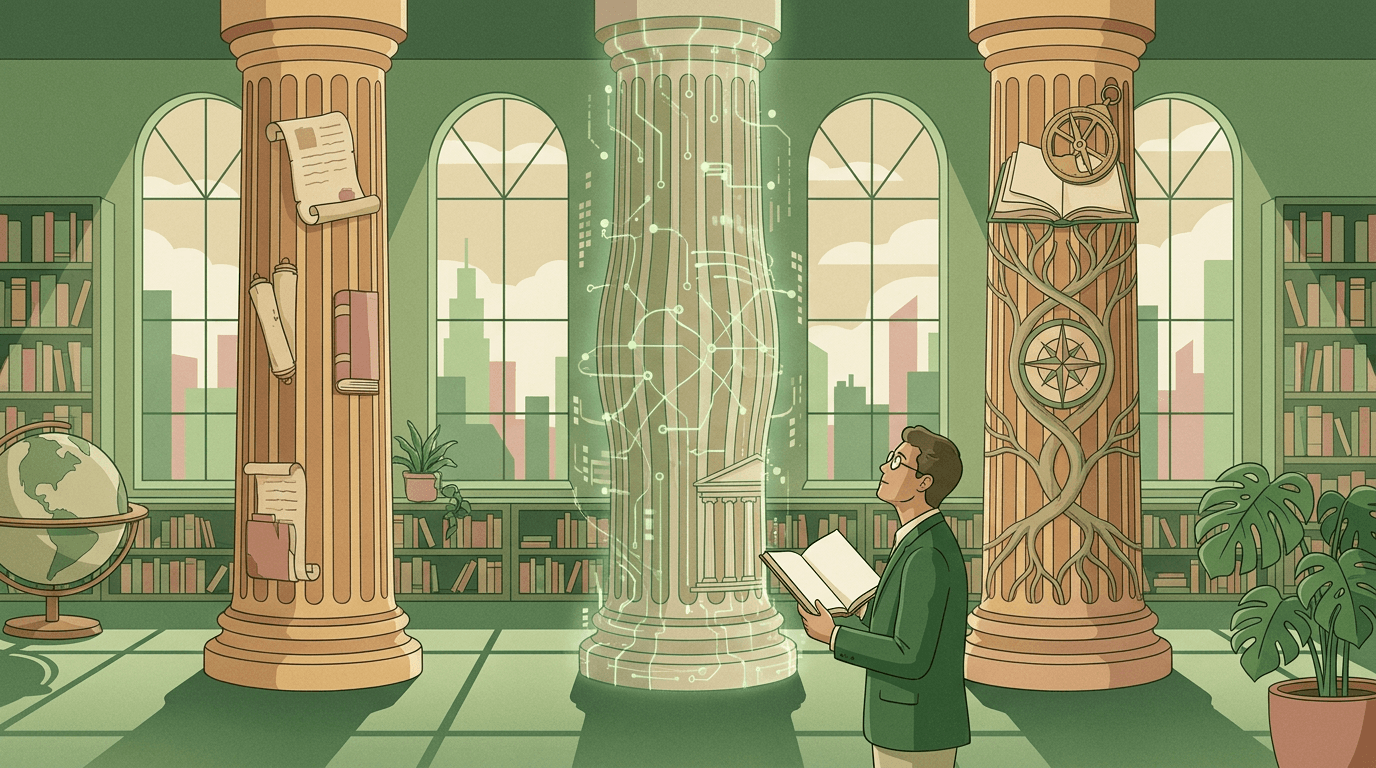
AI Doesn't Break Trust. It Changes Which Pillars Carry It.
Earlier this month, I was at a board meeting for a university press, talking about AI.
Earlier this month, I was at a board meeting for a university press, talking about AI.
The room was full of people who have spent careers inside academic publishing. They wanted to talk about agents, scraping, licensing, training data, all the surface-level questions. Underneath all of that, though, was an older question. One that goes back about 360 years.
In 1665, the Royal Society had a problem. Discoveries were being claimed in coded letters, sealed envelopes deposited with academies, anagrams. Galileo announced the phases of Venus as an anagram so he could prove priority later. The Royal Society's answer was Philosophical Transactions — a new institution that could timestamp a discovery, on a date, and stand behind it.
That role — *we stand behind this* — has been the foundation of academic publishing ever since. Through the printing press. Through the modern journal. Through digital distribution. The role didn't change. The way it was performed did.
We're in another transition. And this one is different.
For the first time, the role itself feels like it's under pressure.
What Publishers Actually Sell
Every disruption conversation reaches for the artifact. Books, journals, the PDF, the subscription, the fulfillment platform. We pick out which of those AI threatens, and we draw conclusions about the industry from that list.
I've sat in plenty of those conversations. They almost always go in the same direction. And they almost always miss what's actually being sold.
The artifact has never been the product.
A publisher is a Trust Institution. It specializes in the monetization of trust. Books, journals, MUSE, fulfillment services aren't what a press sells. They're vehicles for how trust is generated, transmitted, and preserved. Those vehicles have changed before. With AI, they'll change again.
Think about Visa. Visa doesn't sell plastic cards. They sell the trust that the plastic represents — the fact that the card resolves at a point of sale anywhere in the world, and the merchant gets paid. The card is just where the trust currently lives. Tomorrow it might be a tap on a phone, or an agent making a payment on someone's behalf. The artifact will keep changing. The trust function won't.
The question for publishers isn't whether the artifact survives. It's whether the trust function does, and through what.
Three Load-Bearing Pillars
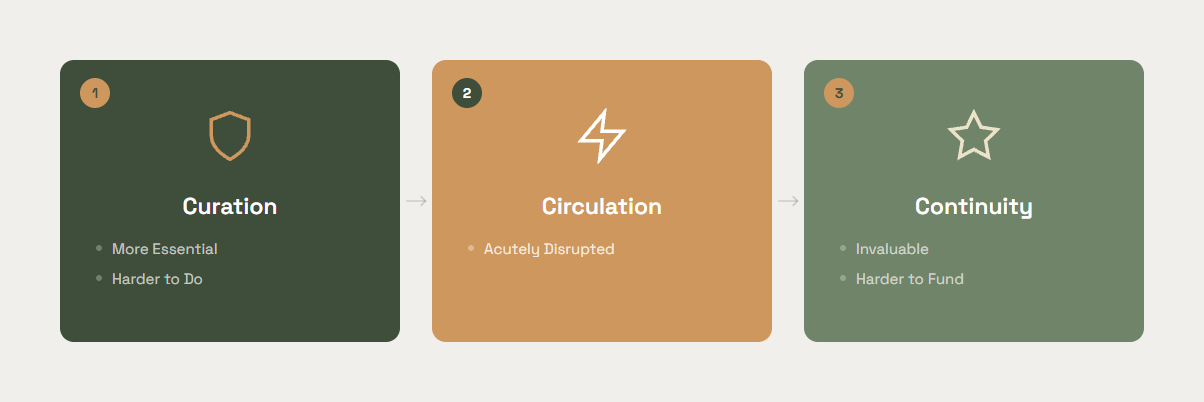
The trust function isn't a single thing. It rests on three pillars that broadly follow the lifecycle of scholarly work.
Curation is everything before the work exists in finished form. Sourcing, selection, development, peer review, certification. More than gatekeeping. This is how publishers *generate* trust — their selection process and editorial judgment are what give readers confidence in the caliber of the material.
Circulation is connecting the published work with the readers who need it. Registration, distribution, discoverability, access, licensing. If circulation were purely about distribution, AI would just be a new channel slotted into the existing framework. It isn't. Circulation is how publishers *monetize* trust — and it's the pillar every revenue line at a university press flows through.
Continuity is preserving the work and the credentials attached to it across time. An archive is a static registry. Continuity is live stewardship: keeping entrusted content available, clean, active, accessible, citable. This is how publishers *preserve* trust.
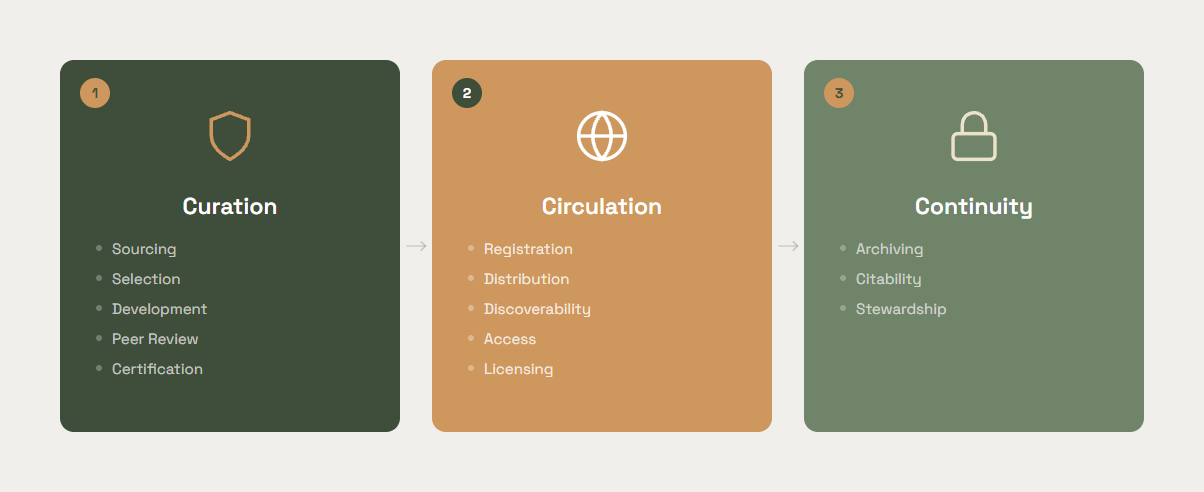
Three different jobs. One underlying function.
What's Actually Shifting
When I look at what's changing for publishers, I don't see disruption. I see three structural shifts in how the system works underneath the disruption.
The interface is shifting. Researchers used to start with Google, their research platform, or their library. Increasingly they start with an agent. They used to search and get back a list of links. Now they ask, and expect an answer. As Hong Zhou and Hiba Bishtawi framed it in a recent Scholarly Kitchen piece, the uncomfortable question is no longer "can humans find this content?" but "will AI agents surface and use it?"
The consumer is changing. For 360 years, the audience has been human — researchers, students, faculty, curious readers, engaging directly with the work. Increasingly that content is being consumed by agents. Sometimes on behalf of a person, sometimes with no human in the loop at all. In a single query, content may touch dozens of agents before any human eyes see a response.
I watched this happen on a panel a few weeks ago. Someone in the room asked a domain question into an agent in real time. The agent answered. The cited source was a publisher's article. Nobody clicked through. Nobody needed to. The trust had already been mined.
Shuwei Fang put it cleanly in The Economist: "The primary consumer in this new market is the machine, and the business models, built over centuries, were not designed for it."
The unit is evolving. For ages, the artifact has been the article, the chapter, the monograph. Increasingly the unit is a chunk of text, a passage, a structured piece of knowledge with attached context. Steve Smith wrote in The Informed Researcher that what AI needs isn't a PDF, it's "a knowledge object: image + caption + equations + methods + provenance, all machine-addressable and rights-cleared."
What unit are we even publishing into?
If a website is something humans browse and an API is something machines query, the unit shift is the same idea applied to scholarship. The article was the website. The knowledge object is the API.
And the measurement is changing alongside it. Clicks, page views, downloads — every benchmark publishers built up over decades is calibrated for a unit that's no longer being consumed.
The Pillars Don't Move Together
The shifts don't line up neatly with the pillars. Some hit harder than others. Some land in places where the press can absorb them. Others land in places where the press doesn't have a structural answer.
Circulation is being captured. Discovery is moving to an interface the press doesn't control. Reading is being substituted by an answer that doesn't need a click. Attribution is being severed even when citation occurs. Research from Kudos that Charlie Rapple shared on a recent panel suggests readers click on cited sources less than 30% of the time, even when the AI cites them. The work was consumed. The trust was built. The reader never knew where the trust came from.
Now line that up against the press's revenue model. Subscriptions monetize circulation. APCs monetize circulation. Fulfillment services monetize circulation infrastructure. Every line on the P&L is downstream of a function being captured by infrastructure none of us control.
Cloudflare publishes the data on this. For every visitor an AI system refers to a publisher's site, Anthropic crawls roughly 38,000 pages. OpenAI roughly 1,500. Google a decade ago — the technology this is replacing — was about two to one. The shape of consumption has changed by four orders of magnitude. The business model hasn't moved an inch.
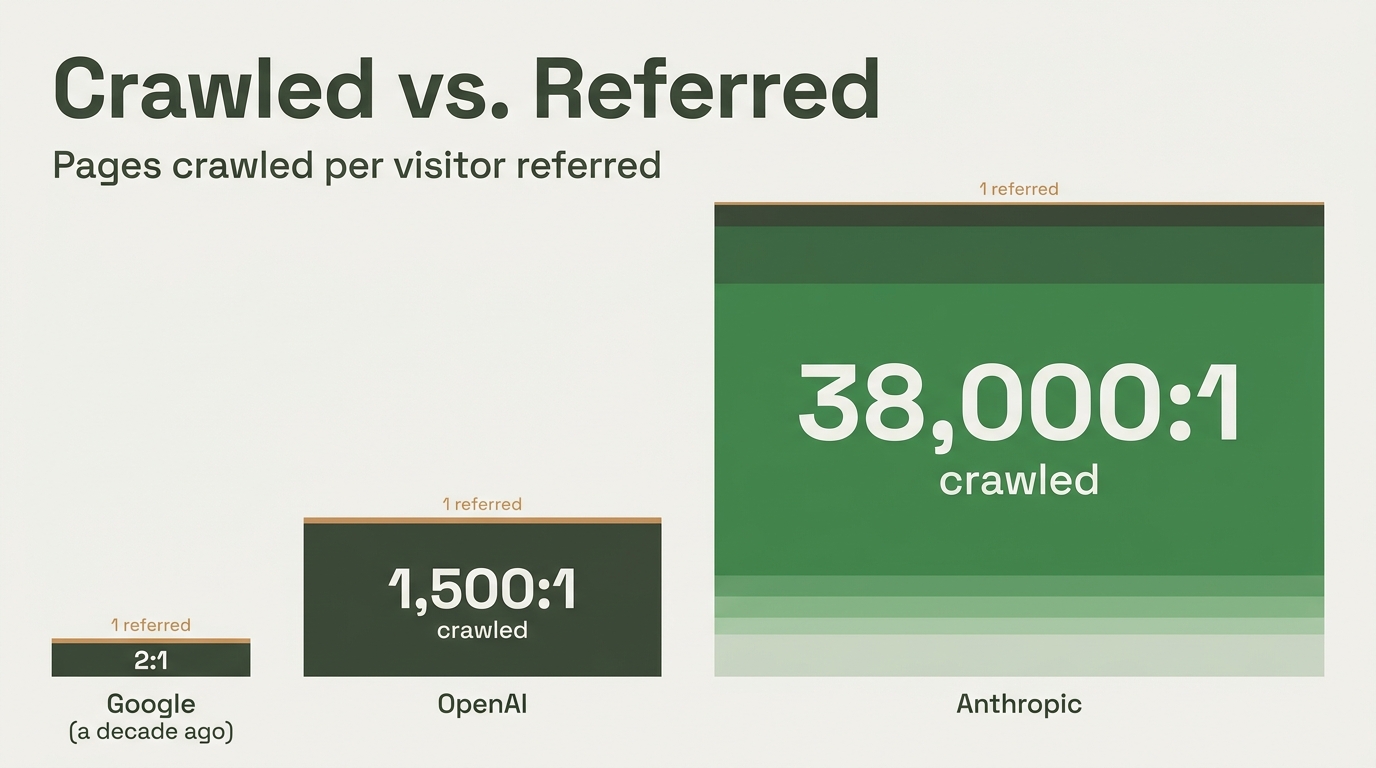
That's not a slow erosion. That's a press whose revenue depends on a function being routed around in real time.
Curation gets harder, and more essential. AI is now excellent at producing the surface signals editors and reviewers have used as proxies for rigor for fifty years. Clean prose. Well-organized argument. Properly formatted citations. Those signals used to correlate with rigor.
They don't anymore.
The curation toolkit can be augmented and partly commoditized by AI — screening, copyediting, plagiarism detection, reference verification. The judgment function cannot.
AI cannot stake a reputation on a decision because it has no reputation to risk. A press can.
The judgment function — *we stand behind this* — cannot be commoditized. The toolkit can. The judgment cannot. Curation isn't lost, but the practice has to evolve. The role becomes more important, not less, in a world where everything looks credentialed on the surface.
The Continuity Inversion
And then continuity, which is where this gets interesting.
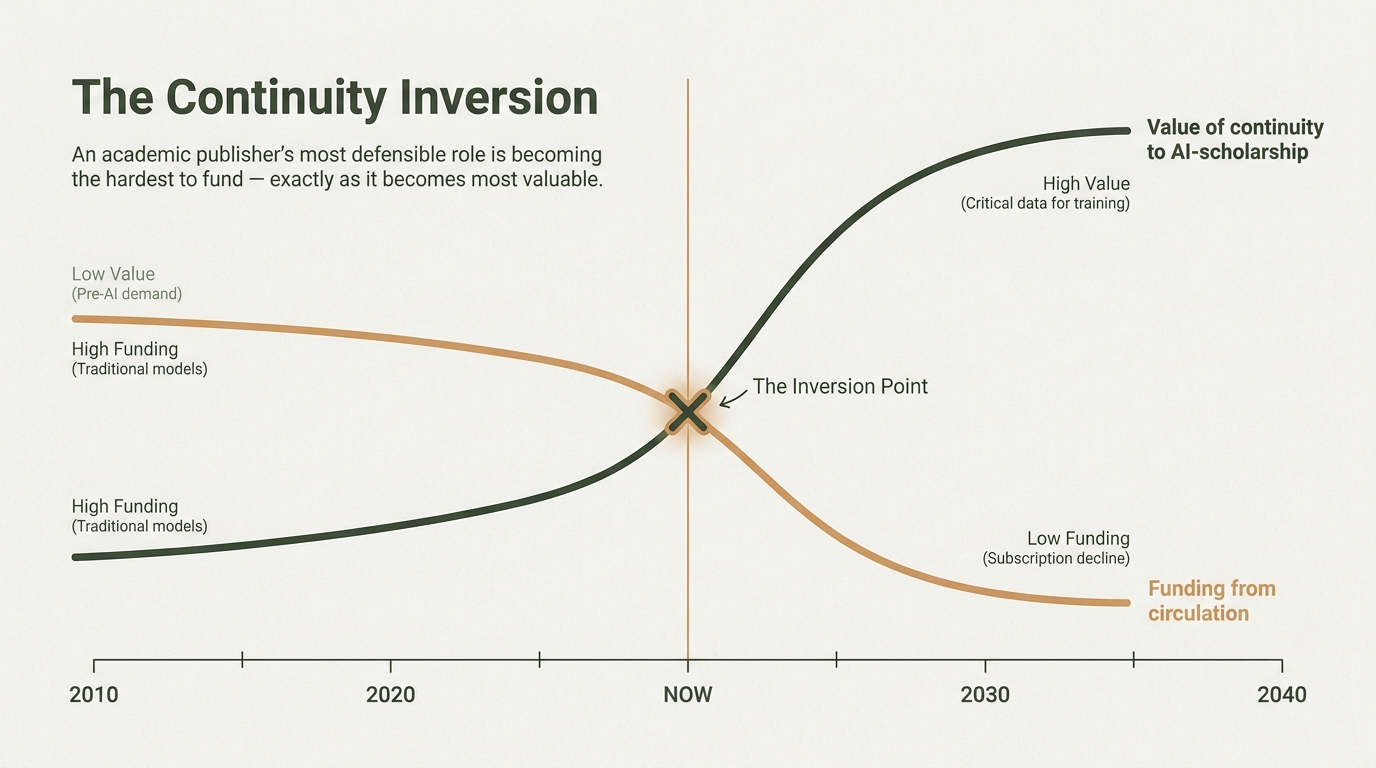
The conventional view of continuity is that it's table stakes. The boring, expensive, important-but-uncommercial commitment to keeping the record intact. The function you fund out of duty.
AI is in the process of inverting that.
AI infrastructure is structurally volatile. Models get deprecated and retrained on 12-to-24-month cycles, and those cycles are accelerating. Outputs are non-reproducible: the same prompt today gives a different answer than it did six months ago, and a different answer to me than to you. Companies pivot, get acquired, wind down.
A 1926 monograph from a university press is still accessible. A 2026 ChatGPT answer isn't.
There's a second-order effect that matters more. An AI-mediated scholarly ecosystem requires trust anchors it cannot generate internally. Verifiable, persistent, citable scholarship is the substrate AI needs in order to be useful at all. If the source can't be verified, the synthesis is unreliable. If citations don't resolve, the AI's output is suspect. The institutions that can credibly say *this work, by this author, in this form, persists and can be verified* aren't doing a service to scholarship. They're providing the foundational layer the entire AI-scholarship pipeline depends on.
And here's the hard part.
The funding for continuity has always lived inside circulation. Subscriptions, MUSE access, one-off book and journal sales. The mechanism that funds the role is collapsing exactly at the moment the role becomes most valuable.
The press's most defensible function is being subsidized by its least defensible one.
That's not a footnote. That's the strategic question every university press has to answer in the next three years.
What Stays the Same
In 1665, the Royal Society's answer to Galileo was a new institution — one that could timestamp a discovery, on a date, and stand behind it. That role has been the foundation of academic publishing ever since.
The role didn't change through the modern journal. It didn't change through digital distribution. It isn't changing now.
AI doesn't break trust. It changes which pillars must carry it.
I don't have a clean answer for what the next institutional form looks like. Nobody does, yet.
But it's worth remembering: the 1665 problem wasn't really about printing. It was about standing behind something publicly. The Royal Society answered that with a new institution. We'll answer it with a new institution too.
The press that builds it won't be the one defending its artifacts.
It'll be the one rebuilding its pillars.
Sources
Keywords Are Not Dead — But Discovery is No Longer Just Search — The Scholarly Kitchen by Hong Zhou and Hiba Bishtawi
Welcome to the World of Machine Audiences — The Economist by Shuwei Fang
Stay in the loop
Get the latest insights on AI, content licensing, and the future of publishing.